Demand Management
That Drives the Entire Operation.
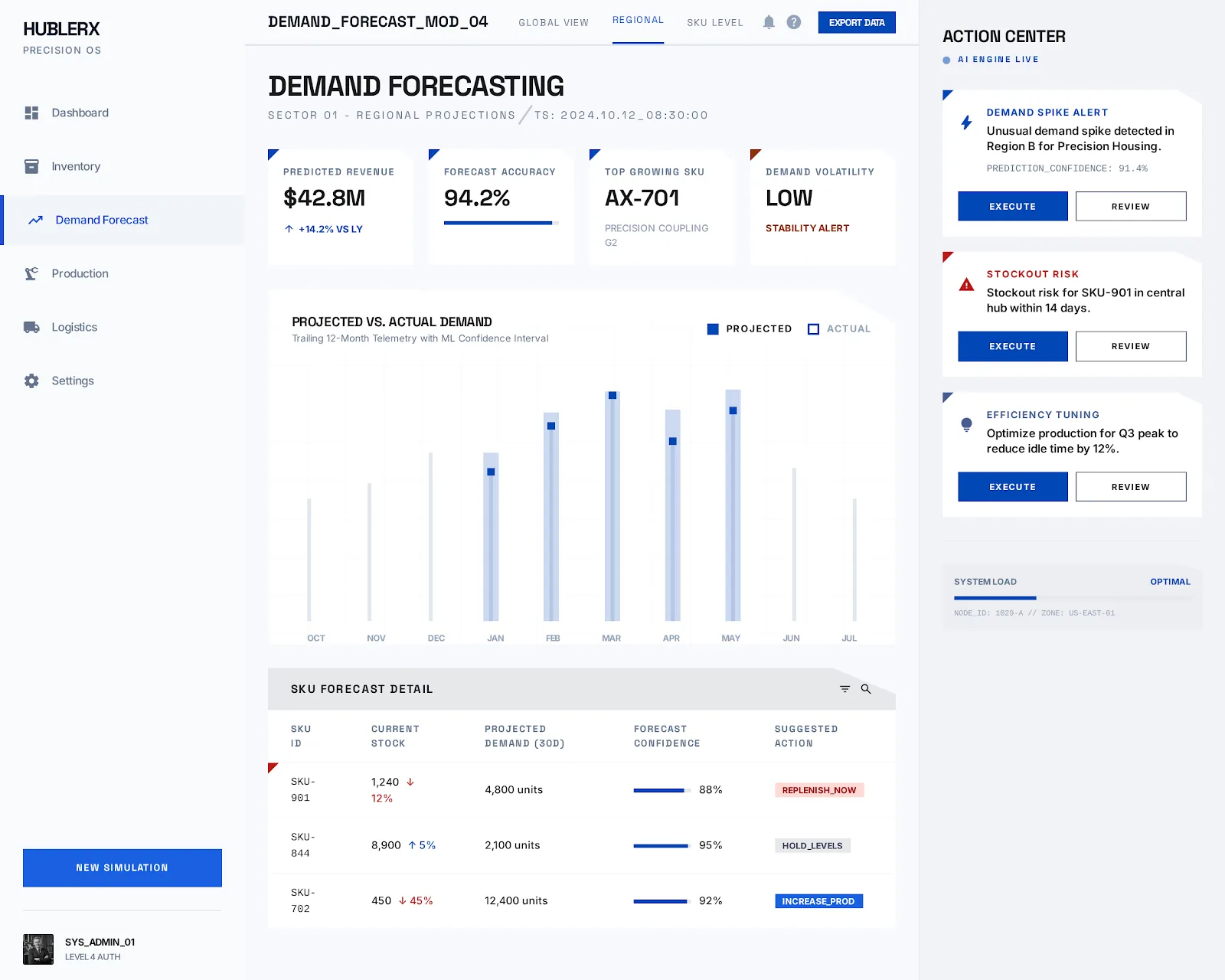
HublerX structures, captures, governs, and translates demand into one live operating layer—turning commercial signals into precise material, capacity, and production instructions.
The Demand Translation Gap
Most manufacturers do not have a forecasting problem. They have a demand translation problem. Fragmented inputs from sales, portals, and historical trends create a distorted signal that fails to instruct the plant.
Isolated CRM Data
Optimistic sales projections without capacity constraints.
Spreadsheet Chaos
Manual adjustments lost in version control.
Delayed EDI
Signals arriving too late for production lead times.
Market Volatility
External shocks ignored by legacy ERP logic.
Demand Foundation
The architecture that maps commercial intent to physical reality. Without the right structure, signals remain noise.
Customer/Channel Mapping
Unify disparate customer IDs and retailer hierarchies into one logical view.
Geography Mapping
Spatial demand clusters for optimized distribution and warehouse assignment.
SKU Hierarchy
Cross-mapping finished goods to components and raw material dependencies.
Plant/Warehouse Mapping
Assigning demand signals to specific manufacturing assets and logistics hubs.
Signal Normalization
Cleansing erratic data spikes to establish a reliable operational baseline.
Live Demand Signal Layer
Confirmed
Hard purchase orders and locked contracts.
Probable
High-confidence forecasts and patterns.
Promotional
Marketing-driven uplift signals.
Channel Inputs
Sell-through data from retail partners.
Unified View
Single reconciled truth across all signals.
Forecasting & Intelligence
Leveraging algorithmic rigor to predict the future state of the factory floor.
Active Intelligence
"The system now accounts for new product analogues automatically, reducing NPI waste by 22%."
Statistical Baseline
Auto-tuned models using historical patterns.
Promotion Uplift
Quantifying impact of commercial activities.
New Product Analogue
Predicting NPI performance via similarity math.
Weighted Pipeline
Probability-based CRM integration.
Horizon Views
Transitioning from short-term execution to 24-month strategic outlooks.
Scenario Management & Simulation
Model "what-if" scenarios for seasonal shifts, project-based demand, and market volatility. HublerX calculates the ripple effects across your supply chain, visualizing the operational impact on labor, machine time, and material availability before you commit to a plan.
Impact Analysis
Real-time capacity stress-testing per scenario.
Version Control
Compare multiple 'Sandboxes' side-by-side.
Dynamic PR/PO Generation
HublerX doesn't just predict; it executes. Demand signals automatically trigger purchase requests and orders, closed-loop with vendor compliance and inventory logic.
Triggered Orders
Automatic PO creation when demand exceeds reorder points.
Vendor Compliance
Integrated logic to ensure orders match contract terms and SLIs.
Not all demand should be treated the same way
Treating every signal as equally real is one of the biggest causes of planning distortion. HublerX helps teams govern demand based on confidence, priority, and operational feasibility.
Confidence-Based Classification
Separate confirmed, probable, promotional, strategic, and at-risk demand so each signal is treated with the right weight.
Priority-Aware Treatment
Distinguish high-priority customers, strategic SKUs, and service-critical demand from lower-priority demand.
Visibility Into Overrides
See who changed a demand assumption, when, and why — with a full audit trail for planning accountability.
Operationally Relevant Decisions
Make demand decisions with downstream implications in view — not in isolation from materials, capacity, or storage.
Exception Management
8 Critical AlertsMaterial at Risk
Demand exceeds material coverage in frozen zone.
Capacity Overload
Target volume violates asset throughput at Plant A.
Underutilization
Low signal creating idle labor and machine risks.
Space Congestion
Projected levels exceed warehouse capacity.
Shelf-Life Exposure
Slow-moving signal for items near expiry.
Service-Level Risk
Potential stockout on A-category SKUs.
Promotion Volatility
Significant variance vs actual uptake.
Source Inconsistency
Conflicting signals between EDI and manual.
The Downstream Translation Engine
A continuous, automated conversion of commercial intent into granular physical instructions across the entire manufacturing stack.
Commercial Signals
CRM, EDI, and market forecasts
Demand Foundation
Entity mapping and hierarchy
Live Demand Layer
Real-time signal normalization
Material Planning
Automated PR/PO generation
Production Planning
Finite scheduling and sequencing
Capacity & Space
Asset and warehouse load balancing
Fulfillment
Downstream logistics execution
Inventory Redux
Lower safety stock via confidence.
Planning Speed
Faster signal-to-schedule cycles.
Service Levels
Top-tier A-class fulfillment.
Waste Redux
Lower obsolescence for perishables.
Visibility
Continuous reconciliation.
Latency
Instant impact visibility.
Connected Modules
Demand management only creates value when it updates the rest of the operating model
Quote, Promotions & Order Management
Govern the commercial signals that create demand in the first place.
Learn more →Material Planning & Supply Readiness
Turn live demand into material requirements and readiness control.
Learn more →Production Planning
Translate demand into executable schedules across plants, lines, and time windows.
Learn more →Inventory, Dispatch & Logistics
Reflect demand changes into allocation, dispatch, and service priorities.
Learn more →Operational Intelligence & Orchestration
Surface demand-led exceptions and route action across teams faster.
Learn more →Bring Your Own Workflow
Extend demand management with custom logic built for your operating model.
Explore Builder →Designed for the complexity real manufacturers face
Food Manufacturing
Promotions, perishability, distributor variability, and shelf-life-sensitive planning across SKUs and seasons.
FMCG
Multi-channel demand, trade promotions, new SKU launches, and distributor complexity that disrupts static plans.
Infrastructure
Project-linked demand, milestone-driven scheduling, and site-specific commitments that change through execution.
Automotive / Chemical
Schedule-sensitive, spec-sensitive, or formulation-driven environments with high execution dependency.
Why HublerX
Built for live demand control, not static planning files
Many systems can forecast. Fewer can structure demand properly, govern it intelligently, and translate it into operational action across materials, production, capacity, storage, and fulfillment.
Who It's For
Built for every role that shapes or responds to demand
Demand planners, commercial leads, supply chain teams, and leadership all work from one reconciled demand signal.
“I build forecasts from live signals — not just the last 12 months of history.”
Signal-driven forecasting
Sales pipeline data, distributor sell-through, customer orders, and market events feed the forecast — not just historical shipments.
Scenario simulation before commitment
Test demand scenarios against supply capacity before locking a forecast — see downstream production and material impact in minutes.
Automatic consensus building
Demand inputs from Sales, Finance, and Operations are captured in one workflow — no offline spreadsheet consolidation required.