Production Planning Software Built on Top of Your ERP
Reliable schedules. Accurate material plans. Real-time floor feedback.
Mid-market manufacturers don't need better planning models. They need their production planning and demand management running on data that's 10 minutes old instead of 8 hours old — without replacing their existing ERP.
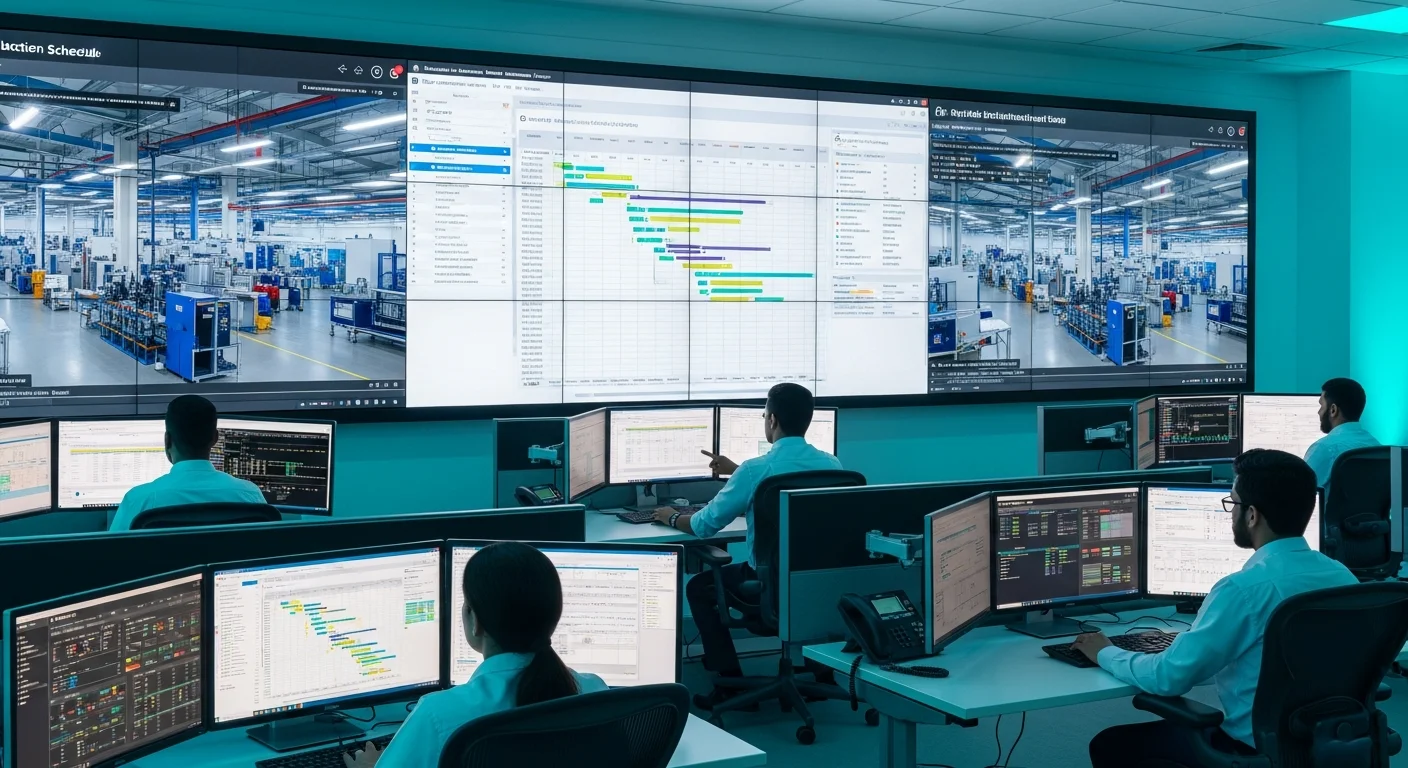
Your Planning Model Is Fine. Your Data Isn't.
Production planning fails in most mid-market manufacturers not because the tools are wrong — but because the data they run on is 4–8 hours old before the planning run even starts. ERP calculates correctly. The inputs it runs on are systematically behind reality. Read: How Stale ERP Data Breaks Production Planning ↗
WhatsApp Order Lag
40–60% of orders arrive via WhatsApp and enter ERP 2–6 hours after receipt. The morning planning run builds a schedule on yesterday's demand.
End-of-Shift Posting
Production events — material consumption, work order completions, quality holds — are posted at end of shift. MRP runs on 4–8 hour-old inventory data.
Quality Hold Lag
Quality holds placed at 9am haven't propagated to ERP inventory by 11am. Planners schedule materials that aren't actually available.
Schedule Adherence Below 75%
Schedules require manual correction within hours of publication. Planners spend their morning re-planning instead of managing exceptions.
Data Currency First
"Mid-market manufacturers don't need more sophisticated planning models. They need the same models running on data that is 10 minutes old instead of 8 hours old."
ERP Was Built for Batch Processing. Not Real-Time Coordination.
In Indian mid-market manufacturing, 40–60% of orders arrive via WhatsApp from distributors and stockists and enter ERP 2–6 hours after receipt. Production events are posted at end of shift. The result is a planning engine that calculates correctly from the inputs it receives — while those inputs are systematically 4–8 hours behind what's actually happening.
Customer sends WhatsApp order at 7pm
Sales rep re-keys into ERP at 9am next morning
8am production schedule built without this demand
Material consumption posted at end of shift, not in real time
Quality hold placed at 9am — not in ERP until evening
TYPICAL_MORNING (WITHOUT_EXECUTION_LAYER)
"Production schedule generated. Based on demand as of yesterday 3pm. 47 open orders. Material available for 38."
"Three orders arrived via WhatsApp last night — not in ERP yet. Re-running manually. Need to call stores to check actual inventory."
"Quality hold placed on Batch B-2204 at 9pm yesterday. Not reflected in ERP. Two production orders scheduled against this material."
Result: Planners spend their morning re-planning instead of managing exceptions. Schedule adherence stays below 75%.
From Hours-Old Inputs to Real-Time Production Planning
The execution layer captures operational events in real time and feeds them continuously into the existing planning engine — rather than waiting for end-of-shift batch cycles that leave the planning system perpetually behind reality.
Orders captured in real time
WhatsApp, email, and PDF orders flow into ERP within 2 minutes of receipt — not 4 hours. The demand signal becomes current.
Inventory posted as it moves
Material consumption, work order completions, and quality holds posted in real time — not at end of shift. MRP sees actual availability.
Exceptions routed immediately
Shortages, quality holds, and capacity conflicts routed to the planner within minutes — with full context for decision.
Planning runs on current data
MRP and production scheduling engine receives current demand, current inventory, and current floor state — producing achievable schedules.
ERP updated continuously
Confirmed outcomes — yield actuals, completion confirmations, quality results — written back to SAP or Oracle as standard transactions.
Better Planning Through Better Data. Not Better Models.
HublerX connects to your existing SAP or Oracle — making the data feeding your planning engine current, accurate, and complete — without touching MRP configuration or replacing your ERP.
WhatsApp & Email Order Capture
Orders from all unstructured channels enter ERP within minutes of receipt. The demand signal feeding MRP becomes current.
Real-Time Inventory Posting
Material consumption and work order events posted as they happen — not at end of shift. Inventory positions reflect actual availability.
Exception Routing Workflows
Shortages, quality holds, and schedule deviations routed to the right person automatically — with audit trail and escalation logic.
Shelf-Life Aware Scheduling
Batch expiry checked against customer minimum shelf-life at the point of scheduling, not at picking. Food and FMCG specific.
Allergen Changeover Enforcement
Allergen changeover constraints enforced as system rules — not supervisor knowledge. Prevents non-compliance automatically.
SAP & Oracle Integration
Connects through standard APIs. Reads production orders, inventory positions, routing data. Writes confirmations back as ERP transactions.
Measurable from the First Month.
Schedule Adherence
From below 75% to above 85% within 90 days — driven by data currency, not model changes.
Order-to-ERP Time
WhatsApp and email orders enter ERP within 2 minutes of receipt, replacing 4-hour manual lag.
Data Lag Eliminated
Real-time posting replaces end-of-shift batch cycles that leave MRP perpetually behind reality.
To Full Implementation
Order intake to ERP integration to exception routing — fully live in a structured 90-day sequence.
Capabilities Standard MRP Doesn't Provide
Food and FMCG manufacturers need planning capabilities that go beyond what standard material planning provides. Three are non-negotiable.
Shelf-Life Aware Scheduling
Batch expiry validated against customer minimum shelf-life requirements at the point of scheduling — not at picking when it's too late. Catches MSL violations before production, not at dispatch.
Allergen Changeover Enforcement
Allergen changeover constraints encoded as system rules enforced before scheduling — not as supervisor knowledge applied inconsistently. Changeover sequences compliant by design, not by hope.
Real-Time Yield Feedback
Actual production yield updates the material balance and schedule immediately as production occurs — not at the next planning cycle. Shortfalls visible within minutes of occurrence, not at end-of-shift review.
Works With Your SAP MRP. Doesn't Replace It.
HublerX connects to SAP or Oracle through standard APIs — reading production orders, inventory positions, and routing data. SAP continues running MRP exactly as today. The execution layer makes the data feeding MRP more current and accurate, and captures the floor feedback that makes subsequent planning runs more reliable.
Standard REST API — no custom development or ABAP
SAP landscape unchanged — additive, not disruptive
Work order confirmations, yield actuals, quality holds written back as ERP transactions
No SAP Basis team involvement required
Production Orders
Read open orders, routing, and BOM from SAP/Oracle
Inventory Positions
Live stock positions updated as events occur — not batch
Quality Hold Status
Hold and release events propagated to MRP in real time
Work Order Confirmations
Yield actuals and completions written back as ERP transactions
From Below 75% to Above 85% Schedule Adherence in 90 Days
The implementation sequence matters. Fix the demand signal first. Then connect to production planning. Then tune parameters. Starting with model changes before fixing data currency produces no lasting improvement.
Schedule adherence typically crosses 80% around day 45–60 as real-time inventory posting takes effect — and reaches 85%+ by day 90 as exception routing workflows reach full coverage.
open_in_newClosing the Planning-Execution Gap in ManufacturingAutomate Order Intake
WhatsApp and email orders enter ERP within 2 minutes of receipt. The demand signal becomes current. The morning production schedule is built on orders received since 6am — not since yesterday afternoon.
Deploy Real-Time Posting
Material consumption and work order completions posted as they happen. Inventory positions reflect actual availability. Material shortages visible at planning time — not at staging time.
Configure Exception Routing
Deviations — shortages, quality holds, schedule breaks — reach the planner within minutes through structured workflows. Schedule adherence typically crosses 85% by day 90.
What You Need to Know
Production planning and demand management software fails in mid-market Indian manufacturing not because the models are wrong but because the inputs are hours old
Three data currency fixes deliver more planning improvement than any model upgrade: automated order intake, real-time inventory posting, and structured exception routing
Food and FMCG manufacturers need shelf-life aware scheduling, allergen changeover enforcement, and real-time yield feedback — capabilities standard MRP doesn't provide
The right implementation sequence: fix order intake first, then connect to production planning, then tune parameters — not the other way around
Frequently Asked Questions
From the HublerX Blog
Why Production Schedules Fail in Mid-Market Manufacturing
How Stale ERP Data Breaks Production Planning
Automating Demand Signals to Improve MRP Accuracy
Real-Time Inventory Posting and Its Impact on Production Scheduling
Shelf-Life Aware Scheduling for Food and FMCG Manufacturers
Closing the Planning-Execution Gap in Manufacturing
From WhatsApp Orders to Accurate Production Schedules
Demand Management for Mid-Market Manufacturers in India
Material Planning Failures and How Real-Time Data Fixes Them
HublerX Helps Manufacturers Close the Gap Between Planning and Execution
Across orders, production, quality, and materials. Most mid-market manufacturers are losing planning accuracy to execution gaps they haven't quantified. A focused assessment identifies where and how much — in two weeks.
Related Guides