Quick Answer
WhatsApp order management for food and FMCG means automatically converting every distributor, kirana, and van sales WhatsApp message — text, voice note, or photo — into a validated ERP sales order, with FEFO-compliant shelf-life checks, customer-specific pricing, and credit enforcement applied at capture. HublerX processes orders in under 2 minutes and posts directly to SAP, Oracle, Dynamics 365, or Tally. See the full WhatsApp order management guide →
Your distributors order by WhatsApp.
Some send voice notes. Some send photos of handwritten pads. HublerX reads all of it.
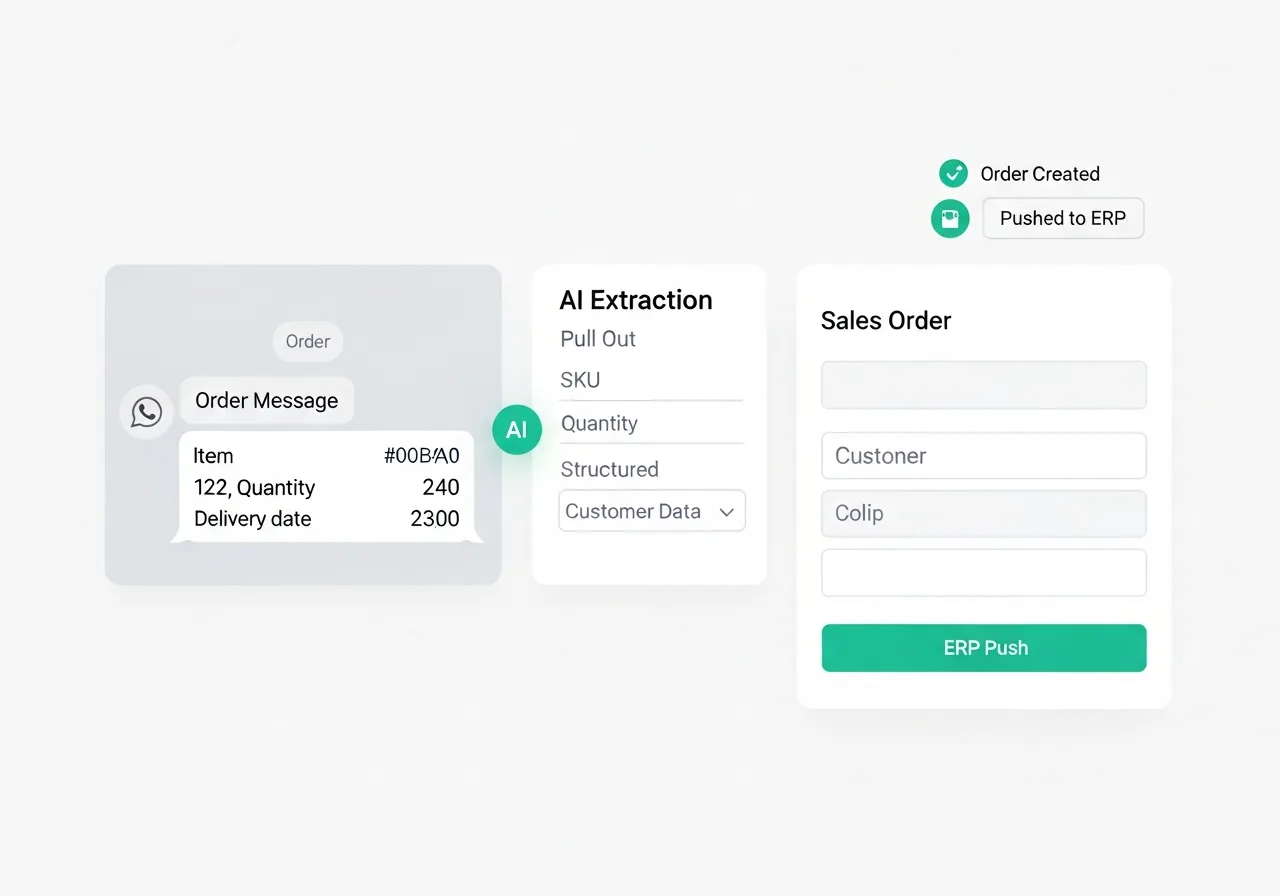
Every message from every distributor — text, voice note, photo of a handwritten order pad, forwarded invoice — processed automatically. Informal product names matched to your ERP item codes. Shelf life checked against available batches before the order is confirmed. The right price applied without anyone looking it up.
All of it in under 2 minutes. Without your team touching any of it.
WhatsApp Orders
of daily order volume arrives via WhatsApp in food & FMCG
Why FMCG WhatsApp Orders Are Different
Three problems generic order tools don't solve. All three happen before dispatch.
Food and FMCG order management has three failure points that generic WhatsApp tools and manual entry both create. All three are invisible until something goes wrong at dispatch, at delivery, or at month-end reconciliation. By then, the cost of fixing them is 8–12× the cost of preventing them.
A distributor who has ordered from you for 8 years calls your products by the names they've always used. "Choco Crunch regular," "mango 200ml," "surf big." None of those are your ERP item codes. Every message needs someone to decode it before a single line can be entered. At 300 orders a day, that's the first 3 hours of every morning.
An order confirmed without checking available batch shelf life against the distributor's minimum acceptance window creates a rejection at delivery — after production has run, dispatch has shipped, and the driver is at the distributor's loading dock. Return freight, credit note, redelivery. The cost of catching it at dispatch is 8–12× the cost of catching it at order capture.
Food and FMCG pricing is layered: base price list, distributor-specific margin, active trade schemes, volume tier, time-limited festival promo. Applying the wrong combination manually across 300 daily WhatsApp orders is systematic margin leakage. Invisible until the distributor raises a debit note or your month-end P&L shows a gap nobody can explain.
Why It's Different
It is not just about capturing the message.
It is about what that message affects.
A generic WhatsApp automation tool extracts text and creates a record. That is not what food and FMCG manufacturers need. Food and FMCG manufacturing software must handle shelf life, complex pricing, and multi-channel order types that don't exist in other industries.
| Factor | Generic manufacturer | Food & FMCG manufacturer |
|---|---|---|
| Order frequency | 10–50 orders per day | 100–1,000 orders per day across channels |
| Pricing complexity | Standard price list per customer | Dozens of simultaneous schemes: volume tiers, regional lists, trade promotions, expiry pricing |
| Inventory sensitivity | Stock availability check | FEFO rotation — wrong batch allocation creates returns and waste |
| Order timing pressure | Next-day confirmation acceptable | Same-day required — van driver needs confirmation before loading |
| Channel complexity | Distributors only | Distributors, kirana, van sales, modern trade, C&F agents — each with different rules |
| Regulatory context | Standard invoicing | GST, e-invoicing, food safety batch linkage, state-specific compliance |
Channel Flows
Every channel your operation runs on — automated
Food and FMCG distribution runs across five distinct channel types, each with its own message format, customer rules, and ERP requirements. HublerX handles all of them through the same pipeline.
Distributor replenishment
Kirana / field sales orders
Van sales real-time capture
Modern trade / institutional
Ramadan and peak season surge
Distributors use their own names.
HublerX translates automatically.
A distributor who has bought your product for eight years doesn't use your ERP product code. They send "Choco Crunch regular" or "mango 200ml" in mixed Hindi and English. HublerX maintains a customer-specific alias library for every distributor — mapping regional names, nicknames, and old codes to the correct SKU without any manual lookup.
Bhai 48 pcs Choco Crunch regular, 24 pcs mango 200ml, aur 12 box waala vanilla pack. Same day delivery agar ho sake.
9:12 AM
Voice Note Processing
Voice note · 0:14 · Raju Traders
Received 9:47 AM
"bhai pachaas kilo choco wala dena, aur teen dozen mango 200 waala, kal tak chahiye"
Shelf life checked at order capture,
not at dispatch.
Confirming an order without checking available shelf life is a recipe for customer complaints, short-dated returns, and wasted production. HublerX validates shelf life at the moment of order capture — before the order is confirmed, before production is planned, and before dispatch is briefed.
FEFO enforcement breaks down
when orders take hours to reach ERP.
Food and FMCG manufacturers know about FEFO. The ERP has the batch expiry dates. The warehouse team knows the principle. But FEFO enforcement fails in practice for a specific reason that has nothing to do with warehouse discipline — it fails because orders arrive too late.
When 200 WhatsApp orders arrive between 8am and 11am, and manual entry takes 15–25 minutes per order, the warehouse begins building the day's dispatch sequence at 1–2pm — with only 60–70% of the day's orders in the ERP. The remaining 30–40% of orders are still in WhatsApp. FEFO allocation runs on incomplete demand, and short-dated stock gets allocated to whichever confirmed orders came first, not to the accounts with the lowest minimum shelf-life requirements.
When HublerX puts every order in the ERP within 2 minutes of receipt, the warehouse has a complete picture of the day's confirmed orders before dispatch planning begins. FEFO allocation runs across the full order set — not a partial one. Short-dated batches go to customers with the lowest remaining shelf-life requirements. Nothing is wasted. No late-arriving order gets a compliant batch that was already allocated away.
The six pricing rules applied on every FMCG order
Pricing complexity in food manufacturing operations is not a minor consideration — it is the variable that determines whether each order contributes margin or erodes it.
Correct pricing applied every time,
with zero manual lookup.
Food and FMCG commercial operations run on complex pricing — customer-specific price lists, distributor margins, trade promotion schemes, volume tier pricing, and time-limited promotions. Applying the wrong price to a WhatsApp order is a margin leak that typically goes undetected until the distributor raises a dispute.
How It Works
From WhatsApp message to ERP sales order in five steps
Order Arrives on WhatsApp — any format
A distributor sends whatever they send. A text message with informal product names. A 14-second voice note recorded from the store floor. A photo of a handwritten order pad. A forwarded PDF from their retailer. HublerX receives every format through the same pipeline — no template required, no behaviour change from the distributor.
AI Extracts Order Details
HublerX AI identifies the customer, maps product descriptions to SKU codes using the alias library, extracts quantities and delivery requirements, and structures the order.
Order Is Validated
Validated against the customer master, price list, active trade promotions, available inventory, shelf-life rules, and credit limits. Exceptions flagged with the specific issue.
Confirmed and Posted to ERP
Valid orders are confirmed automatically. WhatsApp acknowledgement sent to the distributor. Order posted to ERP — triggering production planning and inventory allocation.
Tracked Through Fulfilment
Every order is visible in real time through production, dispatch planning, shipment, and delivery. Automatic status updates sent to the distributor at key milestones.
End-to-End Flow
What happens between the WhatsApp message and the delivery truck
HublerX is the automation layer that sits between your distributors' WhatsApp and your ERP. Here is every step — from message receipt to delivery confirmation — and what HublerX does at each one. This is what food and FMCG manufacturing orchestration looks like when order management is automated end to end.
Message received
Distributor, field rep, or van driver sends WhatsApp — text, voice note, photo, or forwarded PDF
AI extraction
Transcription + NLP extracts customer identity, SKUs, quantities, delivery date from any message format
Customer & SKU resolution
Customer matched to ERP account. Every product name resolved to ERP item code via alias library
Validation & pricing
Shelf life checked batch by batch. Pricing applied across all active schemes. Credit limit enforced
ERP order created
Valid orders posted to ERP automatically. WhatsApp acknowledgement with SO number sent to distributor
Downstream propagation
Confirmed orders flow to production planning, procurement, and material requirements instantly — no manual handoff
Dispatch planning
Warehouse sees the complete confirmed order set. FEFO-compliant batch allocation runs on all orders, not just the ones already entered
Delivery tracking
Order visible in real time from confirmation through loading, transit, and delivery. Status updates sent to distributor at key milestones
Delivery confirmation
Delivery receipt triggers ERP goods issue, invoice generation, and automatic update to the distributor's order history and credit ledger
What Changes
When you remove manual order entry
For most food and FMCG manufacturers, WhatsApp order processing ties up two to four commercial team members for the first two to three hours of every morning. HublerX removes that daily bottleneck entirely.
The Operational Change
The operational change across four functions
When order capture is automated, the change is not just faster order entry. Each team in your operation works differently — earlier, with better data, and without the daily scramble that starts the moment WhatsApp opens at 8am.
Commercial team
2–4 team members tied up for the first 2–3 hours every morning, manually reading and entering WhatsApp orders. Pricing lookups for every order. Distributor calls to clarify unclear messages.
Order entry disappears from the morning schedule. The commercial team moves to managing exceptions, scheme adherence, and distributor relationships — not data entry. 85–90% of orders auto-processed by day 90.
Production planning team
Complete demand picture for the day arrives at 1–2pm, after manual entry catches up. Production planning runs on yesterday's actuals, not today's confirmed orders.
Full confirmed order picture available by mid-morning. Production planning, material requirements, and procurement triggers run on complete data — not a partial view of what happened to be entered first.
Warehouse and dispatch team
Dispatch planning starts with 60–70% of the day's orders confirmed. FEFO allocation runs on an incomplete order set. Short-dated batches misallocated because late orders are excluded from the plan.
All orders in ERP within 2 minutes of receipt. Dispatch planning runs on 100% of confirmed orders. FEFO allocation is optimised across the full day's demand. Returns due to short-dating at delivery drop sharply.
Finance and accounts team
Pricing disputes on delivered invoices. Credit limit breaches discovered at month end. Manual reconciliation between WhatsApp chat logs and ERP orders.
Zero pricing disputes on auto-processed orders — the correct scheme was applied at capture. Credit breaches caught before order confirmation. Clean, complete ERP data from day one with no manual audit trail.
For Large Distributors
You're not the manufacturer.
You're the one with 400 retailers ordering at 9pm.
Most of this page describes how food and FMCG manufacturers use HublerX. But large distributors have the same problem — and often a harder version of it.
You have hundreds of retailer accounts. Each one orders differently. Kirana owners send "same as last week plus 20 butter 100g." Modern trade procurement sends a scanned PO. Sub-distributors send a voice note at 11pm.
Every one of those needs to become an ERP transaction with the right price, the right credit check, and a confirmation back to the retailer before they call to ask if their order was received.
HublerX is built for exactly this. The alias library learns each retailer's individual language — not just your product catalogue. The credit enforcement catches over-limit orders at capture, not at month-end. And the pricing engine applies your retailer-specific tiers, active schemes, and volume discounts without a single manual lookup.
The distributor operation at 90 days
Before HublerX
After HublerX
GCC Edition
Built for UAE, Saudi Arabia, and Kuwait food manufacturers and distributors
Food and FMCG distribution in the GCC has four requirements that the standard platform handles natively — but that generic WhatsApp order tools don't touch.
Bilingual processing
GCC distributors and retailers send orders in Arabic and English — often in the same message. "لبن العمرة" and "Almarai Laban" and "almarai 1L" all resolve to the same SKU. The alias library maintains Arabic and English entries side by side. No translation step. No latency.
Shelf life with export and modern trade rules
GCC modern trade accounts (Lulu, Carrefour, Sultan Center) have stricter minimum remaining shelf life requirements than domestic trade — typically 66–75% of total shelf life at delivery. HublerX enforces per-customer minimum shelf life rules at order capture, including the stricter GCC modern trade standards.
VAT at order creation
UAE (5%) and KSA (15%) VAT applied at order capture against live ERP customer master data. Not a separate calculation. Not a reconciliation step. Applied at the moment the WhatsApp order is processed.
Ramadan demand scaling
GCC food and beverage demand spikes 2–4× during Ramadan for relevant categories. Shelf-life validation and FEFO allocation scale with the volume automatically. Your team handles the same number of exceptions during Ramadan as any other week.
Arabic + English
processed natively in same alias library
bilingual messages handled without a translation step
66–75%
GCC modern trade minimum shelf life enforced
per-customer rules applied at order capture
6 weeks
to first auto-processed Arabic-language order
including bilingual alias library seeded from history
Key Capabilities
Built for food and FMCG distribution
Multi-format capture
Text messages, voice notes, photos of handwritten order pads, forwarded invoices, PDF attachments — all processed through the same pipeline. A distributor recording a 14-second voice note gets the same confirmed sales order in SAP as one who typed a structured message.
SKU alias library
Customer-specific product name mapping per distributor and stockist, updated continuously.
Shelf-life validation
FEFO-aware order confirmation checks available batch stock before confirming the order.
Automatic pricing rules
Customer price lists, trade promotions, volume tiers — applied at order capture, every time.
Discount approval routing
Off-list discounts routed for approval before order confirmation — no exceptions skipped.
Credit limit enforcement
Orders exceeding customer credit limits flagged before posting to ERP.
Multi-language processing
English, Hindi, Arabic, and regional language order messages handled natively.
ERP integration
Direct posting to SAP, Oracle, Dynamics 365, Tally, and food industry ERP systems.
Automatic acknowledgement
WhatsApp confirmation sent to the distributor on order receipt and again on confirmation.
Real-time fulfilment tracking
Order status visible from confirmation through delivery, with distributor-facing updates.
Where This Leads
Reactive today. Proactive at day 42.
Every order processed by HublerX teaches the system something. By day 42, it knows each distributor's reorder cycle, their typical basket, and which SKUs move faster in which regions. At that point, the system stops waiting for messages and starts predicting them.
Reactive capture
Every WhatsApp message processed automatically. Voice notes, photos, informal names — all resolved. 89% auto-processing by day 90.
89% auto-processed by day 90
Proactive order suggestions
HublerX predicts what each distributor will order next and sends a pre-filled suggestion before they've thought about ordering. They reply YES. The order processes.
74% of suggestions accepted without changes
Autonomous ordering
For distributors with stable patterns who opt in, HublerX raises the weekly order automatically — notifies the distributor, gives them a 2-hour cancel window, and writes to ERP if no change is requested.
96% of autonomous orders proceed unchanged
Stages 1 and 2 are active from day one. Stage 3 is opt-in and activates once pattern stability thresholds are met.
Built for Your Market
Built for the markets where WhatsApp is the distribution channel — not an alternative to it
Markets where WhatsApp is the dominant distributor communication channel, where distribution networks run on personal relationships rather than structured procurement portals, and where ERP adoption at the distributor level is low.


FAQ
Frequently Asked Questions
Common questions from food and FMCG manufacturers evaluating WhatsApp order management.
Related Pages
Built for Food & FMCG Manufacturers
See WhatsApp order management built for food and FMCG
Tell us your top 5 product categories, your distribution channel mix, and your ERP. We'll show you HublerX reading a real distributor message — with your SKU formats, your FEFO rules, your active trade schemes — and posting a validated ERP order in under 2 minutes. Your shelf-life and pricing rules run live from day one.
Book a Demo