
Handling RFQs from WhatsApp, Email, and PDFs Without Manual Rework
Your customers won’t change how they send RFQs. Your intake process needs to handle all of them.
Pillar Guide
RFQ Automation Software: The Complete Guide
RFQs don't fail because your team can't quote. They fail because inbound demand arrives fragmented across WhatsApp, email threads, and PDFs — and every format forces a different manual routine before anyone can price, promise dates, or commit capacity.
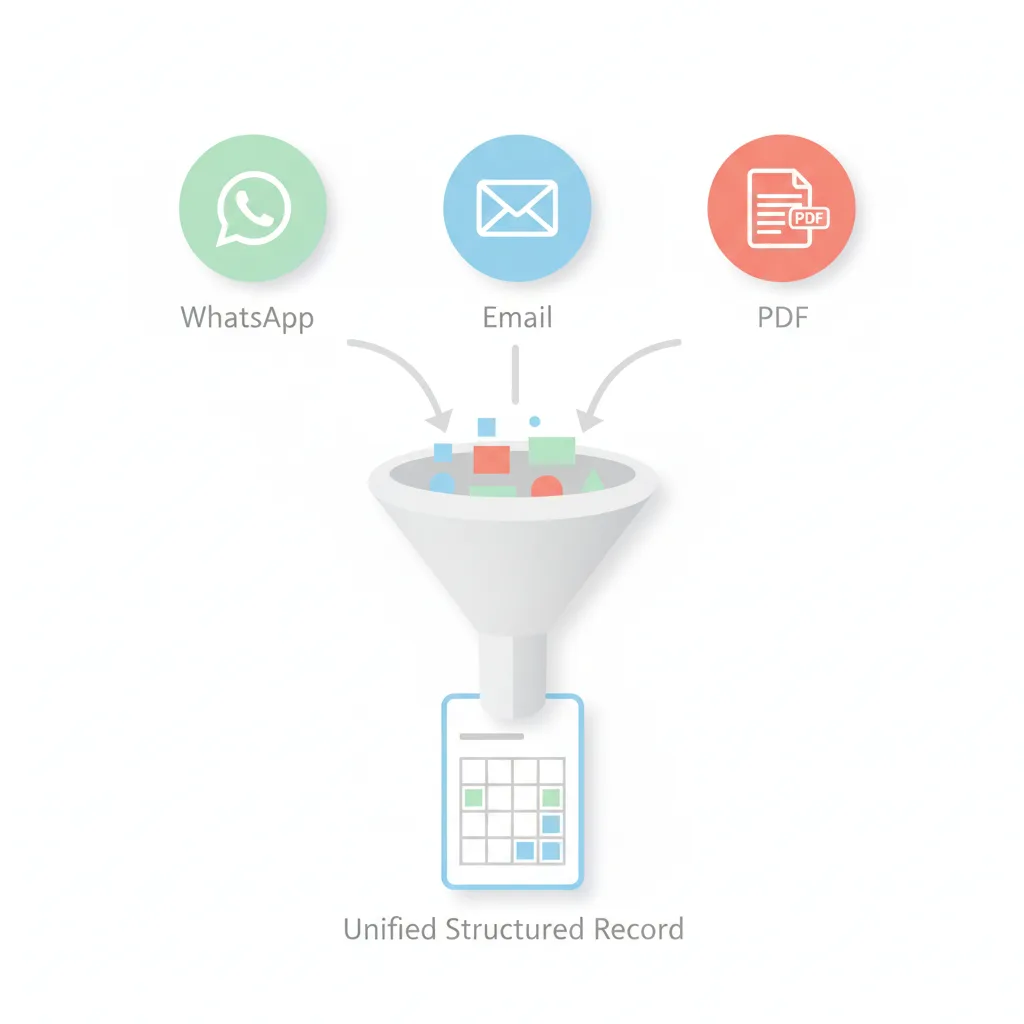
The cumulative cost is significant: every RFQ that requires manual interpretation adds delay, introduces error, and consumes the attention of people who should be focused on commercial decisions.
The Multi-Channel RFQ Reality in Manufacturing
Most factories now receive RFQs through a mix of channels, none of which align naturally with how internal systems are designed:
WhatsApp: photos of labels, screenshots of spreadsheets, short text messages with partial specs, voice notes describing requirements informally
Email: attachments, forwarded threads, inline tables, multiple revisions in the same chain, last-minute addendums buried in reply threads
PDFs: scanned documents, supplier templates, print-to-PDF exports from Excel, multi-page specification sheets with inconsistent formatting
The operational problem isn't that these channels exist — they exist because customers find them convenient and won't stop using them. The problem is that they create multiple entry points into the same quoting process with no consistent structure.
Why These Formats Create Errors and Delays
RFQs arrive as unstructured data
Common failure modes: - Missing fields.
Incoterms, delivery address, or required lead time absent from the request - Ambiguous units
Manual interpretation doesn't scale
- Transcription errors — SKU codes, quantities, decimal points misread from low-resolution scans
- Normalisation errors — units of measure, date formats, and terminology that differ between customer vocabulary and internal standards
- Mapping errors — customer part numbers that don't correspond to internal SKUs without a lookup step
Quoting becomes a coordination problem
If intake data is incomplete or inconsistent, every downstream function wastes time asking clarifying questions. A one-hour delay at intake creates a half-day delay by the time it cascades through the quoting chain.
The Modern Approach: Unify RFQ Intake Into One Workflow
The goal is a single intake pipeline that captures everything arriving through any channel and converts it into the same structured representation — regardless of source.
A unified intake approach operates in three stages:
Capture: ingest RFQs from WhatsApp exports, shared email inboxes, uploaded documents, and customer portals into a single queue with version control
Extract: convert content — text, tables, and images — into structured line-item fields with consistent labelling
Standardise: normalise units, map SKUs against the internal master, validate required fields, and route exceptions to the right person
When every RFQ ends up as the same structured object, quoting becomes a measurable, improvable process.
Core Capabilities That Make Multi-Channel RFQ Intake Reliable
AI extraction that works across document types
A production-ready system handles: email body and multiple attachments treated as one RFQ bundle, PDFs with mixed layouts, and images from WhatsApp including photos and scanned handwritten notes.
Extraction consistently produces: customer part number or description, quantity and unit of measure, target price if provided, required delivery date, packaging requirements, and special instructions.
Data normalisation and validation
- Unit standardisation — converting "dozen" to 12 pcs, reconciling kg and g, handling pack-size conversions
- Date normalisation — resolving format differences and informal expressions like "end of month" or "ASAP"
- Field validation — flagging missing tolerances, incomplete addresses, or conflicting delivery date requests
- Duplicate detection — identifying the same RFQ resent with minor edits
SKU mapping and master data alignment
SKU mapping should: match customer part numbers to internal SKUs with explicit confidence scoring, surface likely matches that need human confirmation rather than auto-applying low-confidence results, and maintain a growing alias library so repeat customers' naming conventions improve match rates over time.
Revision control and audit trail
A robust intake workflow needs: a single RFQ record with all linked messages and attachments, clear identification of the latest revision with change history at the line-item level, and notifications when a revision arrives after quoting has begun.
Business Outcomes You Can Measure
Reduced manual effort per RFQ: fewer manual touches before quote-ready status, faster handoff to the quoting team, and lower exception rate.
Faster response time without sacrificing accuracy: intake stops being a bottleneck, missing information is flagged at receipt rather than discovered mid-process.
Higher accuracy and fewer downstream surprises: structured intake with explicit validation reduces incorrect quantities, misquoted items due to unresolved SKU ambiguity, and rework caused by quoting on an outdated drawing revision.
Key Takeaways
- 1WhatsApp, email, and PDFs each create different manual interpretation steps before quoting
- 2A one-hour intake delay creates a half-day delay cascading through the quoting chain
- 3The goal is one structured RFQ record — regardless of which channel the request arrived through
- 4SKU mapping and revision control are the two most common sources of downstream errors