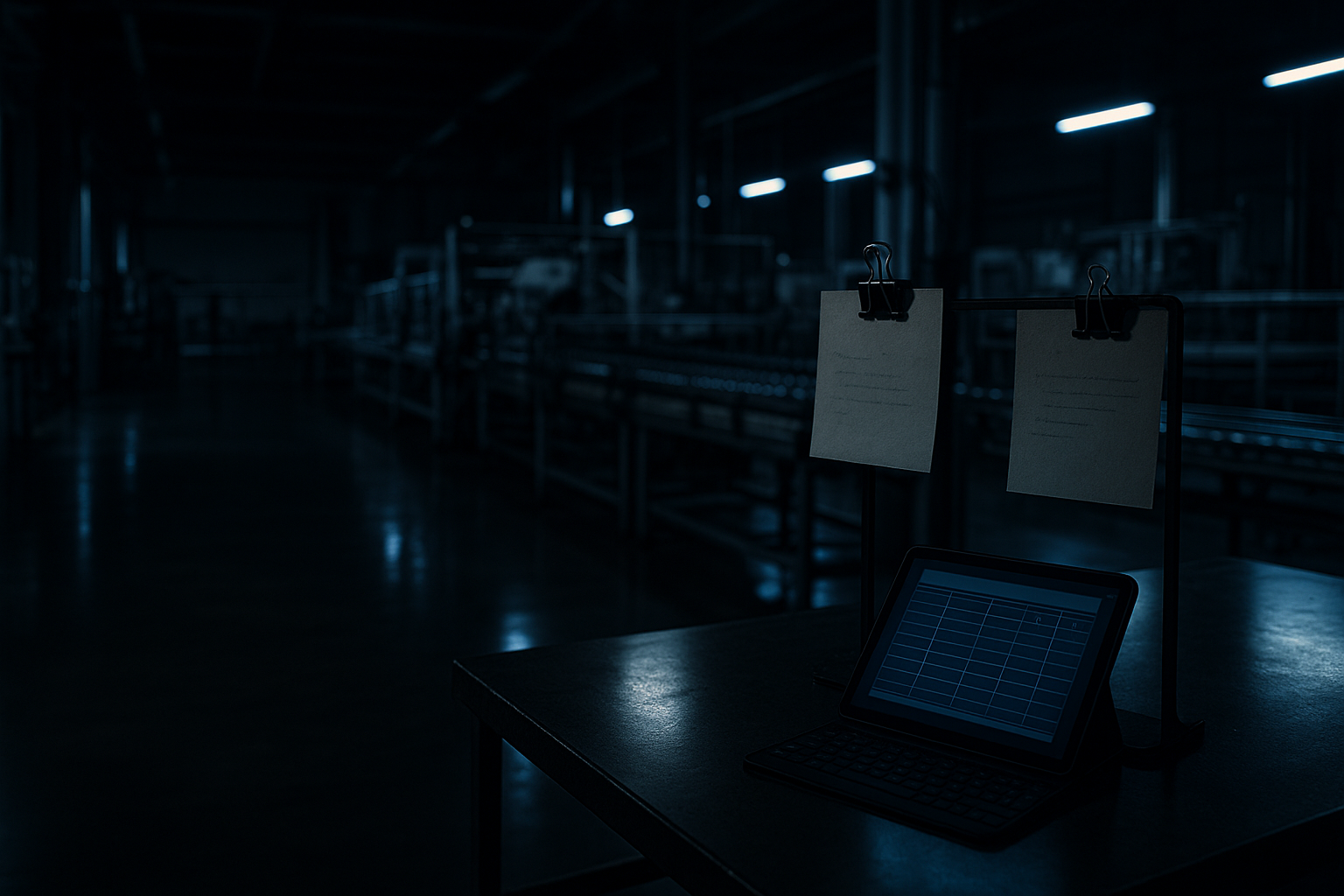
Poor Promotion and Pricing Control Is a Silent Margin Killer
The margin killer in most manufacturing businesses is not the market. It is the internal pricing process.
Pillar Guide
Pricing & Promotion Management Software: The Complete Guide
Most margin erosion is not caused by a competitor's price move. It is caused by your own discounts becoming unmanaged — applied ad hoc, approved informally, and repeated without accountability.
Discounts and promotions start as deliberate commercial tools. A discount to acquire a new customer. A promotion to move slow-turning stock. A price concession to retain a strategic account under competitive pressure. Each of these is a legitimate commercial decision when made deliberately, with visibility into the cost and a defined expectation of the return.
The problem is that most manufacturing businesses have no system that maintains that deliberateness at scale. Discounts accumulate without review. Promotions run past their end dates.
Price concessions granted for specific situations become permanent reference points. And the margin impact of all of it is invisible until it appears as an unexplained gap between the gross margin the finance team models and the gross margin the P&L delivers.
The Anatomy of Margin Erosion Through Uncontrolled Pricing
Uncontrolled pricing and promotion erodes margin through four distinct mechanisms that typically operate simultaneously.
| Mechanism | How It Starts | How It Compounds |
|---|---|---|
| Discount normalisation | Exception discount granted to close a deal | Customer treats it as standard; rep extends to similar accounts |
| Promotion overrun | Promotional rate not enforced at end date | Customers continue claiming promotional pricing; rate becomes de facto standard |
| Approval erosion | Approval process becomes a rubber stamp | Approvers lose context; every request gets approved regardless of merit |
| Stack accumulation | Multiple discount types applied to same transaction | Combined effect falls below margin floor; no single person sees the full picture |
Discount normalisation is the most insidious mechanism because it is invisible at the transaction level. Every individual discount is either within policy or approved as an exception. The problem is the pattern: the same exception being approved repeatedly for the same customer, or the exception rate for a customer tier drifting upward over time as each approval becomes a reference point for the next.
Promotion overrun is technically preventable but practically common. When the system does not enforce the promotion end date, enforcement depends on rep knowledge and diligence. Neither is consistent.
Customers who received a promotional rate continue to quote it on subsequent orders. Reps who do not know the promotion has ended continue to honour it. By the time the commercial team audits the promotion outcome, the overrun has run for weeks.
Approval erosion happens when the volume of approval requests exceeds the approver's capacity to evaluate them meaningfully. A regional sales manager receiving twenty discount approval requests per week cannot assess each one against the customer's margin history, the competitive context, and the cumulative pattern of approvals for that account. They approve based on the rep's stated rationale, which is always compelling.
The approval process exists but provides no control.
How Controlled Pricing and Promotion Management Works
Controlled pricing and promotion management replaces the informal approval chain with a configured system that applies commercial rules consistently, routes genuine exceptions to the appropriate authority, and maintains the data that enables meaningful commercial review.
The four capabilities that distinguish controlled from uncontrolled management are as follows.
System-enforced parameters. The pricing engine applies discount rules, promotion eligibility checks, and margin floor enforcement at the point of quote generation rather than relying on post-hoc approval to catch breaches. A rep who attempts to apply a promotion to an ineligible customer, or to extend a promotion past its end date, receives an immediate system-level response rather than a human approval that may or may not happen.
Structured exception handling. Situations where the standard rules do not apply.
Genuine competitive situations, strategic account negotiations, new customer acquisition deals
Promotion lifecycle management. Every promotion has a defined start date, end date, eligible customer list, eligible product scope, and budget cap. The system enforces all of these automatically — promotional rates are available to eligible customers within the promotional window and not available outside it, without requiring manual deactivation by reps or managers.
Commercial intelligence from transaction data. The aggregate data from thousands of individual pricing and promotion decisions — which customers receive above-average discounts, which promotions drive genuine incremental volume, which reps approve at above-average rates — becomes available for commercial analysis. This intelligence is what transforms pricing from a cost-control exercise into a commercial capability.
The Business Case: What Changes and When
The margin recovery from moving to controlled pricing and promotion management follows a predictable curve.
In the first quarter, the primary impact is cost reduction: closing the compliance gap by enforcing existing rules that were previously being breached without consequence. Manufacturers typically recover 0.5–1.0% of gross margin in this phase simply by enforcing the rules they already have.
In the second and third quarters, the primary impact is process improvement: approvals happen faster, exceptions are documented and reviewable, promotions close on schedule, and the commercial team has data to work with rather than intuition.
By the end of the first year, the primary impact is commercial improvement: the data from controlled pricing reveals which accounts are genuinely profitable, which promotions drive genuine volume uplift, and where the commercial team's effort is generating returns versus where it is subsidising demand that would exist anyway.
The cumulative margin improvement over twelve months typically runs 1.5–3.0% of gross revenue — recovered not through price increases but through the elimination of unnecessary concessions and the redirection of commercial investment toward activities that generate real returns.
Key Takeaways
- 1Margin loss often comes from unmanaged discounting, not competitive price pressure.
- 2If pricing lives in spreadsheets and chats, there is no enforceable source of truth.
- 3Rule-based guardrails reduce exceptions while keeping sales flexibility.
- 4Approval workflows should trigger only when margin risk exceeds thresholds.
- 5Real-time quote margin visibility prevents bad deals before they reach invoicing.