
Why Manufacturing Quotes Break — And How to Eliminate RFQ Chaos
Most manufacturers lose deals before pricing is even discussed. Here’s why — and what to fix.
Pillar Guide
RFQ Automation Software: The Complete Guide
Most manufacturers assume quotes are lost on price.
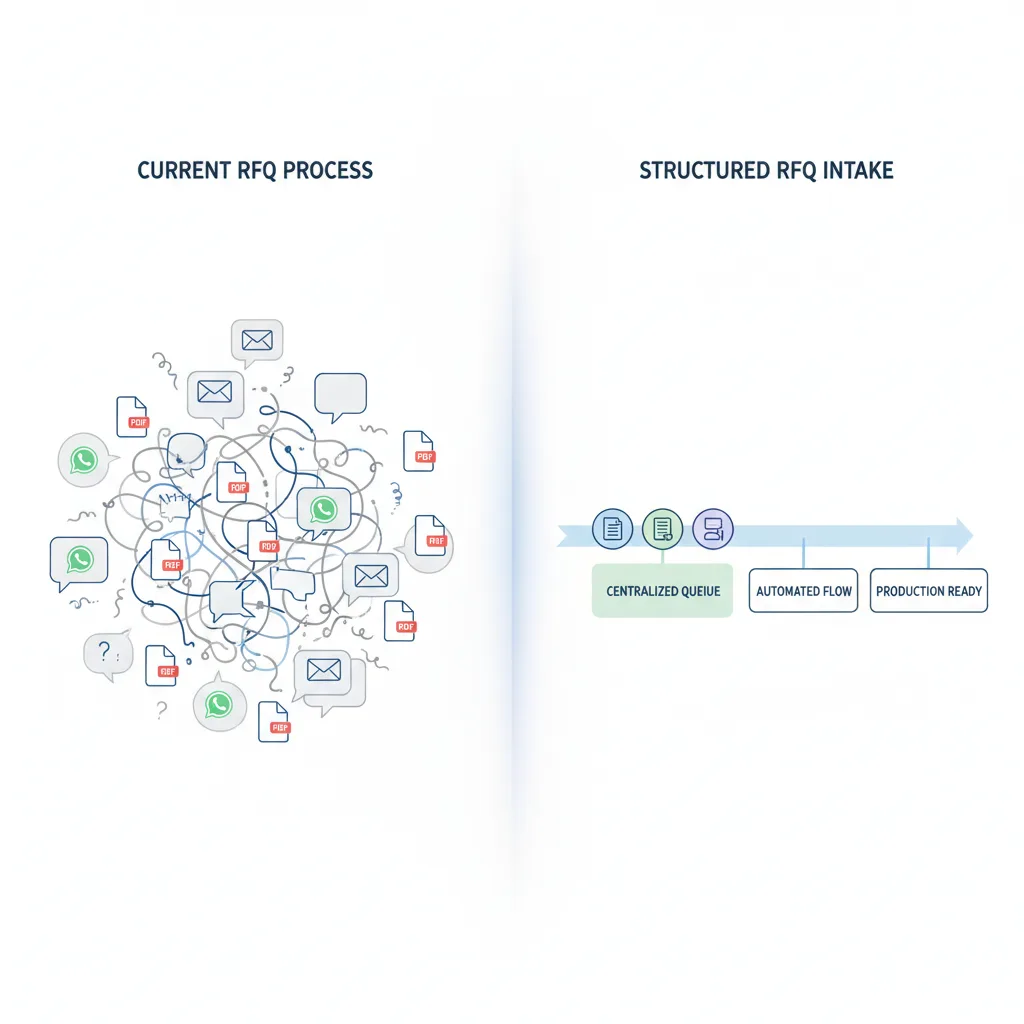
They're not.
Quotes break long before pricing enters the conversation. They break at intake — when an RFQ arrives as a WhatsApp screenshot, a forwarded PDF, or an email thread with four versions of the same request — and no one has a reliable way to convert it into something the business can actually act on.
The result is predictable: pricing errors, delayed responses, inconsistent discounting, and deals lost to competitors who simply responded faster and more accurately.
In this guide, we break down exactly why manufacturing quotes break — and what it takes to build a quoting process that doesn't.
What Is RFQ Chaos — and Why Is It So Common in Manufacturing?
RFQ chaos is what happens when the quoting process has no consistent intake, no standardised data model, and no defined workflow between the moment a request arrives and the moment a quote goes out.
It's common in manufacturing for a structural reason: RFQs arrive through channels that were never designed for operational processing. WhatsApp is convenient for customers. PDFs are how engineers share specifications. Email is how commercial teams communicate. None of these formats were designed to feed a quoting system — yet that's exactly what manufacturers ask them to do, every day.
The Hidden Cost of RFQ Chaos
The visible symptoms are late quotes and awkward holding replies. The less visible cost is operational — quoting becomes a coordination problem that drags multiple teams into rework on every single request.
Common failure modes:
- Incorrect pricing from misread product specs, pack sizes, or delivery terms
- Over-discounting when a sales rep guesses at previous prices without access to approved pricing rules
- Missed discounts — contract tiers, volume breaks, negotiated customer rates that aren't visible to whoever is building the quote
- Delayed responses because engineering, planning, or finance must clarify details that should have been captured at intake
- Zero auditability because decisions are buried in email threads, WhatsApp chats, and personal spreadsheets
RFQ chaos also creates a damaging feedback loop: when the quoting process is unreliable, sales teams build their own workarounds — personal spreadsheets, copy-paste templates, private price lists.
Why Quote Errors at Intake Become Factory Problems
A misread unit of measure becomes a pricing error that either loses the deal or destroys margin on the win. A missed delivery term creates a dispute at invoice. A skipped quality clause triggers a rework requirement after production.
The quote is where those failures are planted. The factory floor and finance team are where they surface.
The Real Problem: Unstructured Inputs, Not Sales Performance
The bottleneck in most quoting failures is format, not effort.
RFQs routinely arrive as:
- "Need 50 boxes urgent"
- "Send best price CIF Dubai"
- "Same as last time but cheaper"
- A PDF with multiple line items and ambiguous product descriptions
- An Excel file with customer-specific naming that doesn't match your master data
Most quote breakdowns happen because there is no consistent mechanism to:
- Extract structured fields (items, quantities, units, Incoterms, ship-to, requested dates)
- Validate and standardise the data (units of measure, pack sizes, product naming conventions)
- Match to SKU master data (including alternates and customer-specific aliases)
- Apply pricing and discount rules consistently and traceably
What High-Performing Manufacturers Do Differently
High-performing manufacturers treat quoting as an execution workflow, not a set of ad hoc tasks. They design a process where every RFQ — regardless of channel — moves through the same controllable stages:
- Capture every inbound request into a single queue
- Extract line items and commercial terms into structured data fields
- Normalise units, product descriptions, and customer references
- Match items to the SKU master with confidence scoring
- Apply pricing rules, volume tiers, and margin floors
- Generate a quote with full traceability
How to Eliminate RFQ Chaos: 4 Workflow Design Principles
1. Standardise the data model, not the channel
Don't fight the channels — customers will keep sending WhatsApp messages and PDFs. Define a single quote data model with mandatory fields and normalise everything to it before quoting begins.
2. Build exception handling for ambiguous RFQs
Auto-quote the clean majority and route the rest to the right person with context. Flag exceptions: low-confidence SKU match, missing unit of measure, conflicting delivery terms, price below margin floor.
3. Make pricing rules explicit and auditable
Define and enforce: approved price sources, discount thresholds requiring approval, volume break logic, and currency and freight handling. When rules are explicit, every quote can be traced back to the rule that produced it.
4. Reduce quote cycle time without losing control
Speed and control are not opposites. Structured workflows deliver faster turnaround on standard requests while explicitly routing high-risk quotes for approval.
Business Impact You Can Expect
- Faster quote turnaround — cycle time compresses significantly on standard requests
- Reduced pricing errors — removing manual re-entry eliminates the most common source of mistakes
- Higher win rates — faster, consistent responses keep you on shortlists competitors miss
- Better auditability — every quote carries a full trail of inputs, assumptions, and approvals
Key Takeaways
- 1RFQ chaos is a structural problem — not a sales effort problem
- 2Incorrect pricing, over-discounting, and missed terms all originate at intake
- 3The fix is standardising the data model, not the channel customers use
- 4Manufacturers with structured quoting workflows respond faster and win more deals