
AI Data Extraction for RFQs: Turning Unstructured Requests Into Quote-Ready Records
The bottleneck in RFQ intake isn’t quoting — it’s the manual extraction step before quoting can begin.
Pillar Guide
RFQ Automation Software: The Complete Guide
RFQ intake is a hidden bottleneck.
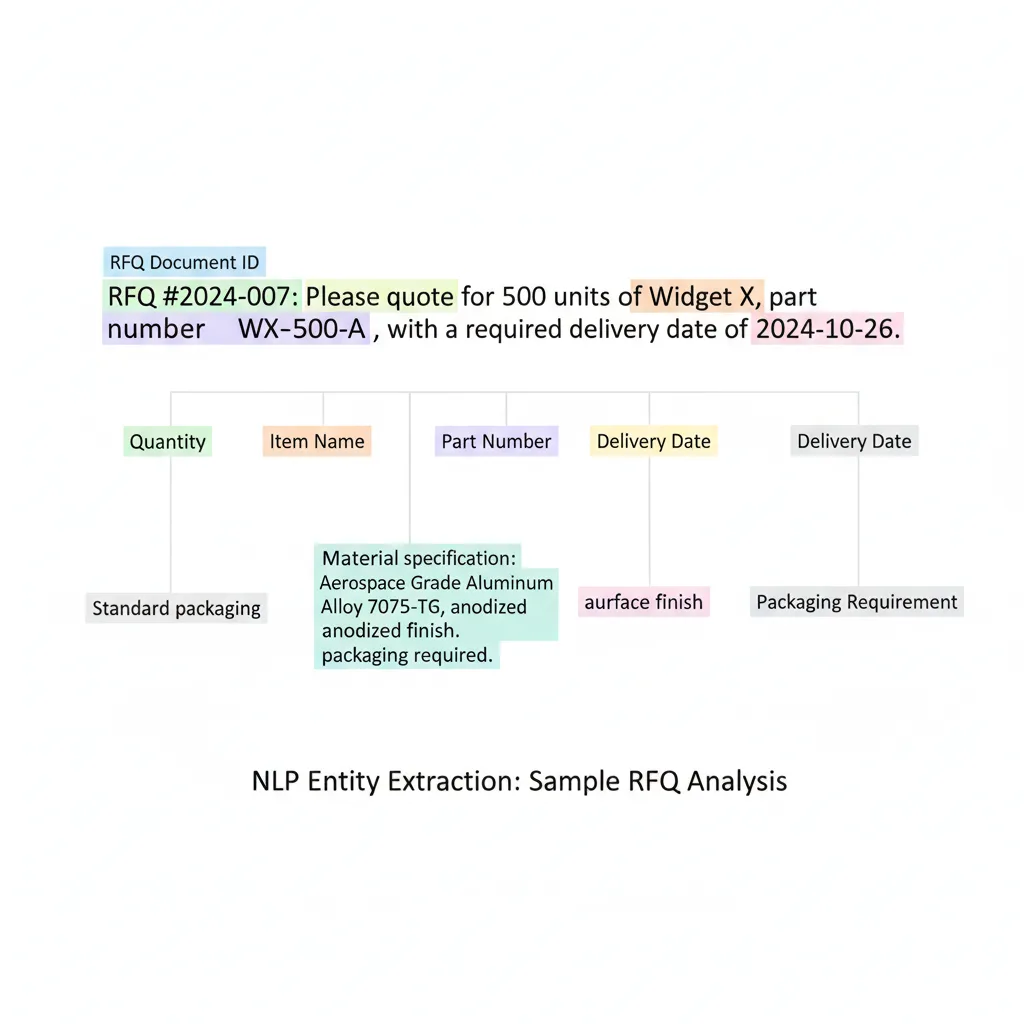
The work isn't quoting — it's the manual extraction of specs, quantities, dates, and constraints scattered across PDFs, emails, and message threads. That administrative drag slows response time, increases errors, and creates avoidable back-and-forth with customers.
AI-based RFQ data extraction addresses the problem at the source: it converts unstructured inbound requests into structured, validated records that downstream quoting systems can use directly — without a human transcription step.
Why Unstructured RFQs Break Standard Quoting Workflows
Common RFQ formats that require extraction before they can be acted on:
- PDF drawings and specification sheets with structured data embedded in tables and free-text notes
- Email threads with changing quantities, updated dates, and revised requirements across multiple messages
- Spreadsheet attachments with inconsistent column names, merged cells, and customer-specific naming
- Photos of labels, barcodes, or handwritten notes shared via WhatsApp
- Partial text messages with abbreviated product references and unstated assumptions
Critical inputs are embedded in free text that varies by customer, by request, and by channel: part number aliases that don't match internal SKU codes, mixed units inconsistent within a single RFQ, multiple ship-to locations, and constraints buried in footnotes.
When intake depends on humans re-keying information from these sources, the process becomes fragile in proportion to volume. Cycle time increases. Error rates rise. There is no clean audit trail.
What AI Extraction Actually Does in RFQ Intake
AI extraction is not a single model making a single decision. It's a pipeline:
- Ingests inbound content — email body, attachments, chat messages, uploaded images — from all configured channels 2. Converts content into machine-readable text using document understanding for PDFs and OCR for scanned images 3.
Identifies relevant entities and line items using natural language processing and pattern recognition 4. Normalises extracted values — units, dates, quantities, part number formats — into a consistent internal schema 5. Maps extracted fields to the target data model the quoting or ERP system expects 6.
Applies validation rules and flags low-confidence items for human review
The goal is consistent, fast, defensible intake where human attention is focused on genuine exceptions — not routine transcription.
NLP: Extracting Meaning from Customer Language
Natural Language Processing interprets customer language and converts it into structured entities:
- Intent detection — distinguishing an RFQ from a change request, order confirmation, or complaint in the same inbox
- Entity extraction — identifying part number, product description, material, quantity, required date, delivery location, and Incoterms
- Constraint capture — pulling out certifications required (RoHS, REACH, PPAP level), inspection requirements, and special process restrictions
- Delivery parsing — interpreting split shipments, expedite requests, and informal expressions like "end of month" or "urgent"
Document Understanding: Finding Structure Inside Unstructured Files
- Table extraction from PDFs and Excel files, handling merged cells, multi-row headers, and inconsistent column ordering
- Drawing reference parsing — identifying revision levels in title blocks and tolerance information in drawing notes
- Multi-page document handling — correctly associating line items with the specifications that apply across multi-page RFQ packages
- Revision detection — identifying when a new document supersedes a previously submitted version
Validation: Turning Extracted Data Into Trustworthy Inputs
Extraction without validation produces structured errors faster. Validation checks:
- Completeness: required fields missing — drawing revision not specified, unit of measure absent, certifications not listed
- Consistency: units that conflict within the same request, delivery dates that precede the manufacturing lead time
- Master data alignment: part number not found in item master, material not on approved supplier list
- Business rules: quantities below minimum order thresholds, items requiring engineering review before pricing
When validation identifies an issue, the system routes a specific, actionable question: "Drawing revision not specified — please confirm whether this is Rev C or Rev D."
The Operational Outcomes AI Extraction Produces
Faster RFQ-to-quote cycle time: the quoting team starts with a structured, pre-validated record and moves directly to feasibility checks, pricing, and capacity review.
Higher accuracy and fewer rework loops: consistent extraction with explicit confidence scoring catches wrong drawing revision, mismatched units, and missing certification requirements before they create downstream problems.
Better execution downstream in ERP and MES: structured intake data enables automatic creation of quote objects in ERP, attachment linking for engineering review, and a clean handoff from sales to operations.
Traceability for disputes and continuous improvement: field-level provenance — tracking which value came from which source document and the system's confidence level — creates a defensible, improvable audit trail.
How to Implement RFQ Extraction
- Define the target schema — specify the quote header and line item fields downstream systems require 2. Start with high-frequency customers and formats — reach reliable performance quickly on the cases that matter most 3.
Add dictionaries and mappings early — SKU aliases, approved materials, UOM conversions significantly improve accuracy 4. Design the human-in-the-loop review for exceptions — make it fast and specific so reviewers resolve flagged items in seconds 5. Integrate with ERP and CRM so extracted data becomes the system of record 6.
Measure outcomes — intake time per RFQ, exception rate, error rate post-extraction, and quote cycle time
Key Takeaways
- 1AI extraction is a pipeline combining NLP, OCR, document understanding, and validation
- 2NLP handles intent detection, entity extraction, constraint capture, and delivery parsing
- 3Confidence scoring ensures low-certainty extractions are flagged, not applied silently
- 4Field-level provenance creates an audit trail connecting what the customer sent to what was quoted