
AI Extraction for Manufacturing RFQs: From Unstructured Input to Quote-Ready Data
A technical breakdown of how AI converts messy RFQ inputs into data your systems can execute on.
Pillar Guide
RFQ Automation Software: The Complete Guide
RFQs rarely show up in a clean spreadsheet.
They arrive as PDFs with inconsistent table formats, forwarded email threads with three versions of the same request, scanned drawings, and WhatsApp messages with incomplete specs. The result is predictable: manual re-keying, missed requirements, slow response times, and avoidable quote risk.
AI-based RFQ extraction solves one specific problem: converting messy inbound requests into consistent, validated fields that downstream quoting and planning systems can execute on.
Why Unstructured RFQs Break Quoting Workflows
Common failure modes:
- Hidden requirements in attachments or email replies ("see revised tolerance on page 3")
- Inconsistent naming — part number vs. customer SKU vs. drawing number
- Mixed formats — PDF table + screenshot + short chat message in the same RFQ
- Ambiguous quantities and dates — "need ASAP" or "for next build"
- Manual copy-paste that introduces errors and version confusion
The failure isn't effort — it's the absence of a structured conversion layer between inbound chaos and internal systems.
What AI Extraction Actually Means in Practice
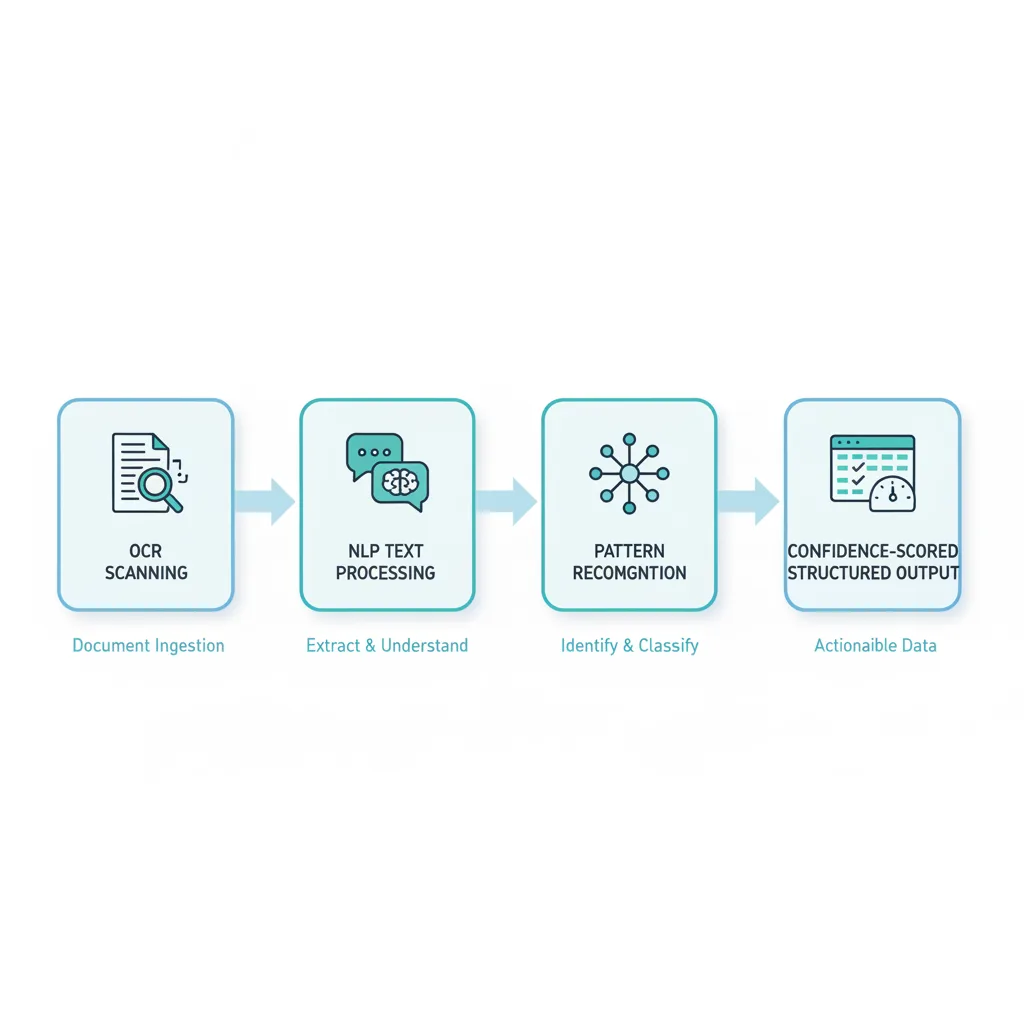
RFQ extraction is not one model doing everything. In practice it's a pipeline combining document understanding, language processing, and validation rules.
At a minimum, the pipeline must:
- Ingest inbound content (email body, attachments, chat exports) 2. Read text from documents — including scans — using OCR and document parsing 3.
Identify the fields that matter for quoting through entity recognition 4. Normalise values into your internal format (units, dates, part number formats) 5. Validate for completeness and internal consistency 6.
Map fields into ERP, MES, or quoting system objects
The goal is quote-ready structure with clear confidence levels and fast exception handling for everything the system isn't certain about.
Core Techniques: NLP, Pattern Recognition, and Data Mapping
NLP for extracting intent and entities
Natural language processing interprets free text in emails and chats. Typical extraction targets: customer name, ship-to, Incoterms, part identifiers, quantities and units, packaging specs, dates, and compliance notes (RoHS, REACH, PPAP level).
NLP also handles sentence-level cues that change meaning — "rev B replaces rev A" or "alternate material acceptable" — that rule-based systems miss.
Pattern recognition for structure in semi-structured documents
Pattern recognition handles:
- Table detection and row/column interpretation in PDFs — including merged cells, rotated text, and multi-page tables
- Key-value extraction ("Material: 6061-T6") from consistently formatted fields
- Drawing and title-block parsing where specs follow consistent placement conventions
- Common RFQ templates from major customers, where layout patterns can be learned and applied
Data mapping into your internal quote model
Data mapping converts customer-facing content into internal objects: quote header (customer, site, currency, due date, terms), quote lines (item, description, quantity breaks, target price), technical requirements (material, finish, tolerances, inspection notes), and attachments linked to the correct line.
Accuracy Comes From Validation and Exception Handling
RFQ automation fails when it pretends everything is certain. Each extracted field should carry a confidence score and field-level validation rules.
Human-in-the-loop for the right exceptions
The fastest teams don't review everything — they review only what's uncertain. A well-designed exception queue surfaces items like:
- "Missing: material specification"
- "Conflicting: rev A in email, rev B in drawing"
- "Unmapped: customer material 'Alu 61T6' — closest match: 6061-T6"
- "Low confidence: tolerance extraction — please verify"
What Changes Operationally When RFQs Become Structured
Faster quoting with fewer handoffs: structured RFQs reduce re-keying time, engineering clarifications caused by missing data, and back-and-forth with sales due to version confusion.
Better downstream planning readiness: when requirements are mapped consistently, operations can act earlier on material feasibility, capacity signals, and standard routing selection.
Cleaner data for continuous improvement: structured RFQ data becomes an analytical dataset — quote cycle time by customer or RFQ type, common missing fields and where they originate, win/loss patterns tied to lead time and spec complexity.
Implementation Notes: Start With the Fields That Drive Execution
A practical starting field set:
- Customer + ship-to
- Part identifier + drawing revision
- Quantity breaks + unit of measure
- Due date + bid due date
- Material + finish (when applicable)
- Attachments linked to the correct line
Expand once the workflow is stable, validation rules are tuned, and exception queues are under control.
Key Takeaways
- 1RFQ extraction combines document understanding, NLP, pattern recognition, and validation
- 2Pattern recognition handles table extraction, title-block parsing, and key-value fields
- 3Human-in-the-loop review targets only uncertain extractions — not full manual re-entry
- 4Start with the smallest field set that unlocks quoting throughput; expand once stable